
Did you know that God’s timing is never accidental—but always intentional?
When I first selected the Psalms for this year’s devotional back in November 2024, I simply arranged them in order, not thinking about what month each one would land. But God knew. In His perfect, sovereign timing, He aligned Psalm 22 and Psalm 23—two of the most studied and prophetic psalms—with the month we celebrate the death and resurrection of Jesus Christ.
What a beautiful reminder that He orchestrates every detail, fitting our lives together like a grand, divine puzzle. I shouldn’t still be amazed… but I always am. I stand in awe of Him.
Due to the number of verses in each psalm, we won’t study them verse by verse, which is how I generally study the Bible, but we’ll do an introduction to both psalms and then a study on each psalm individually.
INTRODUCTION
Both Psalms were written by King David who was also a musician. Anyone studying the life of David (found in first and second Samuel), will know that he was an adulterous and murderer. But, he was still a man after God’s own heart, despite his sin nature. Why? Because he repented and recognized God’s sovereignty. Even though David sinned, he understood there were consequences to his sin. Those consequences visited him through his family. Despite the consequences of his sin, David always praised the Lord, even when he suffered terrible distress.
Psalm 22 was most likely written in David’s later years because it reflects the hardship he suffered. Biblical scholars seem to think it was written sometime around 1000 BC, contrasting with Psalm 23 which was written while he was a shepherd tending his father’s sheep years earlier.
Psalm 22 has thirty-on verses and Psalm 23 has only six verses. These two psalms are powerful in their own right and often studied together because of their contrast and complement—suffering and trust, despair and hope, the cross and the Shepherd.
Psalm 23 is often read at funerals because of the comfort it gives those who mourn, but it is a comfort we can use throughout our life… not just when someone we love dies.
Psalm 22 is categorized as a lament psalm, but it also a Messianic psalm because it points to the death of Jesus whereas Psalm 23 is a psalm of trust, wisdom and thanksgiving.
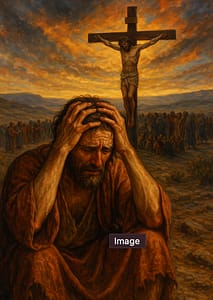 PSALM 22
This psalm has several key themes including
In the opening of this psalm, David cries out to God. The words he used are the very words Jesus cries out to God on the cross and can be found in Matthew 27:46 and Mark 15:34. Even unto death, Jesus quotes the scriptures which were written centuries before He was born.
While the Psalm is about David’s distress, we cannot mistake the correlation to Jesus’s crucifixion. I find it interesting (and so like God) to use a sinful (but repentant) man to give prophetic words about the sinless man, Jesus Christ.
While both men had spiritual and emotional suffering, Jesus did not sin. And yet, David remembered God’s faithfulness to him. It reminds us that God is faithful to us, even when we are not faithful to Him.
There is so much of this psalm that is prophetic in nature that I will try to line up the psalm verses with the prophecies fulfilled by Jesus in the New Testament. I have created a summary table with these fulfillments. If you would like to have the table, email me and I will provide it to you.
These prophecies are unmistakably fulfilled by Jesus when he suffered and died on the cross. Again, it’s fitting for us to study this Psalm this month.
Psalm 22 takes a decisive turn in verse 21 where David transitions to praising God then it closes with a a vision of future generations proclaiming God’s righteousness—a victory ending after the suffering, pointing to the resurrection and eternal reign of Christ. The Psalm ends in triumph despite the trials.
Have you ever felt abandoned but later saw God’s hand?
 PSALM 23
Psalm 23 is one of the most beloved and well-known of all the psalms. I would be remiss if I didn’t include it in our “Walk Through The Psalms” devotional. The Psalm starts with trust and forms a bridge between Psalm 22 and Psalm 23.
For as short and compact as this psalm is, it has several key themes:
David shows a confidence in God, declaring and trusting in Him. The psalm continues by showing us David’s peacefulness, his rest, and contentment. God’s guidance is purposeful and personal. David then goes on to express his confidence that God will be with him even when there’s danger and suffering. (I believe this is a foreshadowing of David being in danger when Saul pursued him to kill him.)
He also recognizes God’s protection and correction, thus giving him comfort. What parent doesn’t discipline his child? We love them and want them to grow up to be adults who do the right thing. Why wouldn’t God do the same to those He loves?
In the end, David shifts to God preparing him a table, even when his enemies all around him and concludes with a beautiful promise.
The correlation between David and Jesus continues in this psalm.
Psalm 23 is a beautiful song of trust and a declaration of faith in that no matter what life hands us, whether it is an overflowing abundance or immense trials, God is with us tending to our every need.
I challenge you to take Psalm 23 and make it into a prayer for yourself. Try substituting your name in the psalm and make it personal to you. God loves it when we pray His Word back to Him.
How is God shepherding you right now?
CONCLUSION
Psalm 22 and Psalm 23 are beautiful Psalms that we can turn to when we are in the midst of trials, remembering that Jesus suffered and died on that cross at Calvary. At this time of year, I often think of a gathering my husband and I attended years ago in California.
What struck me at that time was when the pastor talked about Jesus on the cross. I don’t remember his exact words, but the idea was that while Jesus hung on that cross, He looked down through the centuries and saw me… then He died for me… for my sins so I could have eternal life with Him. And He did the same for you!
I hope this study of Psalm 22 and 23 blessed you as much as it blessed me to prepare it.