
Overview
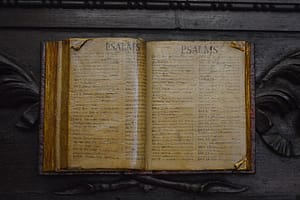 Those who don’t regularly read the Bible or study it, know the basics. But there’s so much more! I’ve been a student of the Bible going on 40 years and I still marvel at all the things I don’t know (or I’ve read a passage and it didn’t click until the Holy Spirit showed me the truth of it.)
On Wednesday evenings at my home church, we are studying through the Psalms… chapter by chapter and verse by verse. While we won’t be doing that in our Walk Through the Psalms, we will go over a wide selection of the Psalms to study. We wouldn’t get through the entire book in ten years time!
For the most part there will be two Psalms but on a few occasions there wil only be one. This devotional will be an introduction to the Psalms.
Many times, the Psalms are referred to as the “hymnbook of ancient Israel”. It’s a collection of songs (mostly written by David), prayers and poems that capture human emotion as a response to God. Every generation throughout the millennia experience the joy, sorrow, repentance, gratitude, and praise in the Psalms.
There are 150 Psalms and are divided into five books which mirror the first five books of the Pentateuch (Genesis, Exodus, Leviticus, Numbers and Deuteronomy). Although my Bible shows the divisions of the books, I must have skimmed over them while reading, and I was surprised to learn they mirrored the Pentateuch and they are categorized (which we will go over later in the devotional). The books are divided like this:
While my Bible indicates who wrote each Psalm (if it isn’t David or unattributed, I tend to skip over that information and just read the Psalm itself. So, who wrote them? As a new believer (years ago), I thought King David wrote all of them. Not so. Fifty Psalms are unattributed, but King David wrote 73 of them where he reflects on personal experiences of worship, repentance, and trust in God. His son, Solomon is credited with writing two of the Psalms. Even Moses got into the act and wrote one! Heman and Ethan of the Ezrahites wrote Psalm 88 and 89 respectively. Asaph, a Levite who was a worship leader, wrote twelve. And the sons of Korah who were known for their temple worship roles wrote eleven.
Further, the Psalms are classified into seven categories. Actual psalms appear in parenthesis):
Praise Psalms cover individual and corporate praise (18, 30, 34, 92 and 47, 67, 95, 96 respectively). In this category there are also Hallelujah (103, 104, 113-118, 135 and 136) and Climactic Praises (145-150). Themes that appear in these Psalms are God’s creation, faithfulness, kingship, and salvation. They provide a rich foundation of worship and remind us that God is to be praised in every aspect of our lives and can be used for our personal devotions.
Lament Psalms express sorrow and seek God’s intervention in times of trouble. These Psalms also have individual and corporate laments (3, 6, 13, 22, 25, 38, 42-43, 51, 57, 77, 88 and 44, 60, 74, 70, 80, 83, 90 respectively.) Themes that appear in these Psalms are complaint, petition, confession, and trust and praise. These Psalms remind and encourage us to bring our deepest emotions to God.
Thanksgiving Psalms offer gratitude for God’s deliverance and blessings. They are divided into individual and corporate thanksgiving (9, 18, 30, 32, 34, 40-selected verses, 66-selected verses, 92, 116, 118 and 65, 67, 68, 75, 107, 124, 136). These particular Psalms have a specific structure. They have an introduction, a narrative, then a call to worship and a conclusion. Their themes include deliverance, provision, forgiveness and faithfulness. They are a wonderful reminder to continually give thanks for what He does but also for who He is. My husband and I incorporate thanksgiving into our daily prayer time. I pray you do as well.
Unlike the three prior Psalm categories, the Wisdom Psalms do not have individual and corporate sections. The list of wisdom Psalms are 1,14, 19, 32, 34, 37, 49, 73, 78, 90, 111, 112, 119, 127, and 128. The themes include the fear of the Lord, the contrast of righteousness and wickedness, God’s law and word, Trust in God, and the brevity of life. Like the Thanksgiving Psalm, there is a structure to these Psalms which includes instruction, contrast, reflection and a call to action. They are intended to guide believers to live faithfully before God. These psalms remind us that true wisdom begins with fearing the Lord and aligning our lives with His truth.
Like the Wisdom Psalms, the Royal Psalms do not have individual and corporate sections. They are Psalm 2, 18, 20, 21, 45, 72, 89, 101, 110, 132, and 144. The themes include God’s sovereignty, the King as God’s representative, Messianic hope, covenantal promises, and victory and blessing. The structure of these particular psalms are the acknowledgment of God’s authority, the celebration of the king, petitions or prayers, and prophetic elements. They celebrate the role of earthly kingship in the world, but God’s ultimate kingship and the coming of the Messiah. They are rich in theology, emphasizing God’s covenant faithfulness and His eternal plan for a righteous and just kingdom. The Imprecatory (comes from the Latin word imprecari, meaning “to invoke” or “to call down curses.”) Psalms contain strong prayers calling for God’s justice and judgment upon enemies. Psalms included are 5, 10, 17, 35, 52, 58, 59, 69, 79, 83, 94, 109 and 137. Themes for these psalms are justice and judgment, vindication, God’s sovereignty, honest emotions and communal concerns. The structure of these psalms includes invocation, complaint, imprecation, and expression of trust. They remind us to bring even our most intense emotions to God because God is both a loving Savior and a righteous Judge. They are beneficial in helping us to understand how to process anger or grief in the face of injustice while trusting God’s ultimate authority to judge rightly. Lastly, but most importantly, the Messianic Psalms which include psalm 2, 8, 16, 22, 23.24. 40 verses 6-8, 45, 68, 69, 72, 89, 102 and 110. The themes include kingship, suffering and rejection, priesthood, resurrection and ascension, and the cornerstone (referring to Jesus, the Messiah as the cornerstone of God’s plan). The Messianic Psalms are structured with a prophetic statement, typology, and dual fullfillment. These Psalms bridge the gap between the old and new testaments, and offer glimpses of Jesus’ mission and identity centuries before his birth. These psalms deepen our appreciation for how intricately God wove His promises of the Messiah throughout Scripture.
Psalm 103 Inspired 10,000 reasons (Bless the Lord) by Matt Redman. It’s one of my of my favorites! From Psalm 92, Shout to the Lord by Darlene Zschech. An all-time favorite of mine. This one draws from Psalm 103:8 and it is titled The Lord is Gracious and Compassionate by Vineyard Worship Psalm 42:1 inspired As the Deer by Martin Nystrom and another of my favorites. Psalm 84:10 inspired Better is One Day by Matt Redman and another of my favorites Based on Psalm 51:10, Create in Me a Clean Heart by Keith Green is another of my favorites. (This is Keith’s original version, but there are other arrangements of this same song.) Based on Psalm 13, Forever by Chris Tomlin is a a more recent contemporary worship song. inspired by Psalm 36:5-6 Your Love, Oh Lord by Third Day praises God’s unfailing love and faithfulness and another of my favorites. It seems many of these are my favorites and I know why… because they are based on scripture! In conclusion, I pray you learned some general information about the Psalms that perhaps you did not know. |
||||
 I would be remiss if I didn’t include a list of contemporary worship songs that are based on the Psalms. When we worship at church and these songs are sung, they are so uplifting. If you don’t know them, I’ve included links to them so you can listen to them and judge for yourself. (Many of these I’ve sung for years.)