
 We continue our journey of *Walking Through the Psalms* with Psalm 119—the longest psalm and chapter in the entire Bible. Interestingly, it sits almost at the center of Scripture and contains a remarkable 176 verses! I may not do this psalm full justice, but I’ll give it my best effort.
Many scholars attribute it to David, written across different seasons of his life, though its authorship remains uncertain. If God had wanted us to know for sure, He would have told us—and perhaps that mystery reminds us that His Word itself is what matters most.
Some believe Psalm 119 was composed during the time of Ezra and Nehemiah, over an extended period, since it lacks the continuous flow of thought seen in other psalms. Instead, it’s a series of meditations that together form a rich tapestry of devotion.
Psalm 119 is arranged in an acrostic pattern: there are 22 sections—one for each letter of the Hebrew alphabet—with eight verses per section. Each verse within a section begins with that same Hebrew letter. (Lamentations 3 follows a similar pattern.) The psalm’s structure reminds us that God’s Word covers everything—from Aleph to Tav (like “A to Z”).
Almost every verse celebrates God’s written revelation—His Word—making it a treasure chest for anyone seeking to grow in faith and obedience.
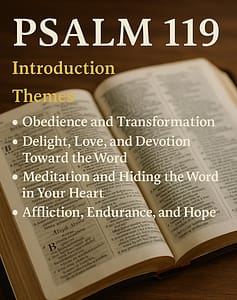
The psalmist treasures the law not as duty but as joy, celebrating the supremacy and sufficiency of God’s Word. While these themes aren’t exhaustive, they provide spiritual “food for thought” as you read through this psalm:
• Obedience and Transformation (vv. 1–3): There are at least five references to obedience and transformation. Can you find them?
• Delight, Love, and Devotion Toward the Word (v. 14)
• Meditation and Hiding the Word in Your Heart (vv. 11, 15)
• Affliction, Endurance, and Hope (v. 50)
• The Character of God Revealed in His Word (v. 68): There are at least six references to God’s character—can you locate them?
• Trustworthy, Enduring, and Guiding (v. 105)
Can you find any other recurring themes in this psalm?
 Sections
Let’s take a look at each section, read the synopsis for each, then answer the study questions at the end, if you are so inclined.
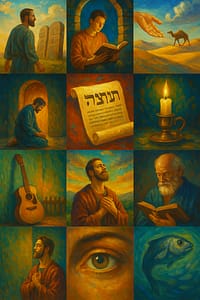
Each letter of the Hebrew alphabet has three aspects: a letter, a numerical value, and a symbolic meaning (shown in parentheses after each letter). These letters carry spiritual significance, and many rabbis taught that creation itself was spoken through these 22 letters.
I find it fascinating that there are three elements tied to each letter—perhaps a reflection of the Trinity itself!
Synopsis: Blessed are those who walk in the law of the Lord; the psalmist seeks to live blamelessly and keep God’s precepts.
Synopsis: A young man keeps his way pure by heeding God’s Word and hiding it in his heart.
Synopsis: The psalmist, a stranger on earth, asks God to open his eyes to the wonders of His law.
Synopsis: In affliction, he clings to God’s Word for revival and strength.
Synopsis: A prayer for understanding, steadfastness, and renewal through God’s statutes.
Synopsis: Confidence in God’s mercy and bold witness in declaring His Word.
Synopsis: Comfort and hope are found in remembering God’s promises during affliction.
Synopsis: The Lord is the psalmist’s portion; he seeks God’s favor and companionship of the faithful.
Synopsis: God’s discipline teaches wisdom and goodness; His Word is better than gold.
Synopsis: Created by God, the psalmist prays for understanding and comfort in persecution.
Synopsis: Though fainting and oppressed, he hopes in God’s enduring Word.
Synopsis: The Word stands firm forever in heaven; through it the psalmist finds life amid trouble.
Synopsis: Love for the law grants wisdom greater than teachers and enemies.
Synopsis: God’s Word lights the path of life; obedience brings joy even in suffering.
Synopsis: Love for God’s law contrasts with rejection of the double-minded and deceitful.
Synopsis: A plea for justice and insight; the psalmist esteems all God’s precepts as right.
Synopsis: The Word gives light and understanding; sorrow fills the psalmist’s heart over disobedience.
Synopsis: God’s righteousness and truth remain steadfast; His commandments bring delight.
Synopsis: Early morning prayers show devotion; the psalmist trusts God’s nearness and truth.
Synopsis: A cry for deliverance and affirmation that the sum of God’s Word is truth.
Synopsis: Despite persecution, he rejoices in God’s Word as priceless treasure.
Synopsis: Final plea for understanding and restoration—’I have gone astray like a lost sheep.’
I pray you’ve been blessed by this devotional and perhaps learned something new about Psalm 119. To dig deeper, read each section and the synopsis provided in this newsletter. Then, prayerfully consider the reflection questions below for each section.
Above all, invite the Holy Spirit to teach you all truth and illuminate God’s Word as you study.